
Built on Deadline, Contested in Practice: Arkansas Adopts Wind Energy Rules Under Act 945
The rulemaking in Docket 25-063-R set the framework for wind permitting in Arkansas, deferred its hardest questions, and immediately generated a rehearing petition.

Arkansas Public Service Commission | Docket No. 25-063-R | Orders 1–7 | October 2025 – February 2026
Abstract
Arkansas’s first comprehensive wind energy permitting framework took effect in 2025 under Act 945 — but its implementing rules, finalized under a statutory deadline in Docket 25-063-R, left the regulation’s most contested question unresolved. Who qualifies for the exemption protecting projects already in the pipeline, and through what process, remains a matter for future case-by-case adjudication rather than codified rule. This analysis provides a complete account of the rulemaking: the parties and positions that shaped Order No. 6, the three provisions actively contested at the December 11, 2025 hearing, the five implementation issues explicitly deferred to future proceedings, and the rehearing petition filed February 13, 2026, challenging the Commission’s treatment of exemptions, installation requirements, and due process. The rules adopted by Order No. 7 on January 14, 2026, are not yet legally effective pending Arkansas Legislative Council approval. When the first exemption application reaches the Commission, it will test a regulatory framework its own drafters acknowledged was incomplete.
Executive Summary
The Rulemaking and Its Outcome
• Act 945 of 2025 created Arkansas’s first permitting regime for wind energy facilities of 5 MW or larger exceeding 200 feet in height, effective August 3, 2025, with implementing rules required by January 1, 2026.
• Docket 25-063-R opened October 8, 2025. Twelve parties intervened. ALJ Justin Craig issued Order No. 6 on December 29, 2025; the full Commission adopted it via Order No. 7 on January 14, 2026.
• The Final Wind Energy Development Rules are not yet legally effective. Order No. 7 conditioned their operative status on approval by the Governor and the Arkansas Legislative Council, plus ten days after filing with the Secretary of State, per Ark. Code Ann. § 25-15-204.
The Central Dispute: The Exemption
• Act 945 exempts projects “under development” as of April 9, 2025 — defined as having executed land leases, commenced necessary state or federal studies, or commenced construction. No permit is required for qualifying projects.
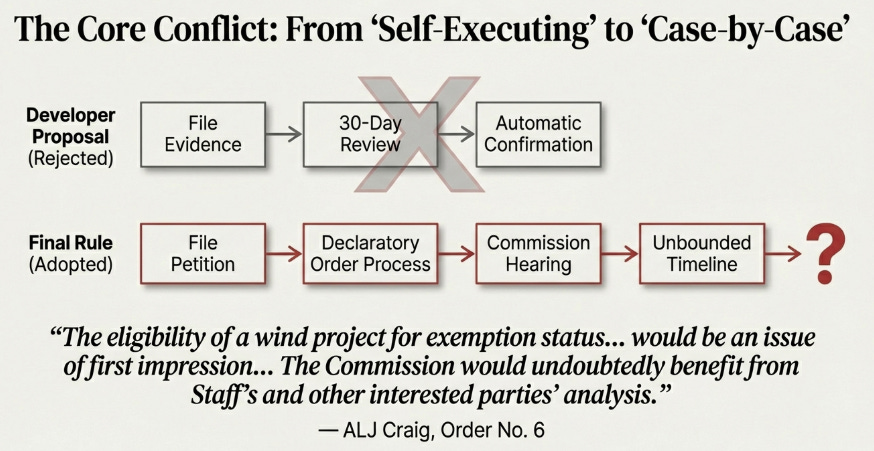
• Developers (Southern Renewable Energy Association or SREA, Steelhead, Triple Oak) proposed codifying the exemption, publishing a non-exhaustive study list, and establishing an optional expedited confirmation process with a 30-day review window.
• Commission Staff proposed a structured permit-application process modeled on Docket 20-049-U, with a 45-day review timeline. No party proposed a longer timeline; no party opposed having a defined timeline.
• The ALJ rejected both proposals. The exemption was not codified, no study list was adopted, and no review timeline was established. Developers seeking confirmation of exempt status are directed to the general declaratory order procedure under Rule 23 CAR § 462-309(b)(1), with no defined workflow or timeline.
• The ALJ flagged that even the “Executed land leases” criterion raises first-impression questions, citing unsworn comments from two state legislators suggesting that leases must cover a defined percentage of project acreage to qualify — a threshold not found in the statute.
• The constitutional challenge to the April 9 cutoff — grounded in Arkansas Constitution Article 5, § 1 and arguing the deadline is retroactively unconstitutional — was declined on jurisdictional grounds. The Commission cannot declare a statute unconstitutional. The issue is preserved for judicial review.
Contested Rules Adopted Over Opposition
• Final Rule 23 CAR § 469-301(a)(1) requires a minimum five-rotor-diameter spacing between turbine support bases of facilities under different ownership. Developers argued there is no commercial incentive to site turbines too closely; the ALJ kept the rule as a consumer protection measure.
• Final Rule 23 CAR § 469-301(a)(2) prohibits wind energy facilities from causing interference to radio, television, or internet reception on adjoining properties. Both developers and utilities opposed it as vague and potentially asset-stranding. Staff’s own witness had received no interference complaints; the ALJ kept the rule grounded in Act 945’s legislative findings.
• Permit holders must file insurance policies, acoustics expert reports, and financial security documentation at least 30 days before commencing construction — creating a Commission review window between permit issuance and construction start.
• The decommissioning rule (23 CAR § 469-401) requires an independent cost estimate and proof of financial security filed in the permit docket at least 30 days before construction. The “independent fiduciary” requirement was replaced with more flexible language at the Joint Utilities’ request.
• The newspaper notice requirement (two consecutive weeks within 30 days before filing) was retained. The Joint Utilities’ proposed flexible alternative was declined in light of community notice concerns arising from the Nimbus Wind Farm project in Carroll County.
Explicitly Deferred to Future Rulemaking
• Five implementation issues were acknowledged as legitimate but set aside due to the statutory deadline: defining “wind energy facility emergency”; clarifying the $2,500 filing fee process; clarifying whether the fee applies to permit renewals; specifying permit transfer requirements; and establishing AOGC coordination requirements for oil and gas areas. No follow-on docket has been opened.
SREA’s Rehearing Petition (February 13, 2026)
• SREA challenges the exemption exclusion as arbitrary — no party opposed including the statutory exemption text in the rules, yet no findings were made explaining the omission.
• SREA invokes an internal inconsistency: if 30 days is sufficient for staff to review insurance and financial security documents, no rational basis exists for refusing to set any review timeline for exemption applications.
• SREA argues any confirmation process must be optional, not required. Act 945 contains no language authorizing Commission approval as a condition of exemption, and the Arkansas Court of Appeals’ 2022 Petit Jean Electric decision held that such requirements exceed the Commission’s statutory authority.
• SREA challenges the land lease acreage finding as relying on unsworn legislative comments as a factual basis — violating the Commission’s own due process precedent that public comments do not constitute substantial evidence.
• SREA challenges §469-301(a)(1) and (a)(2) as unnecessary to implement Act 945 and, specifically as to the communications interference prohibition, as preempted by federal law — a constitutional bar that, if sustained, would void the rule on its face.
What to Watch
• Arkansas Legislative Council approval vote — rules are not legally operative until this step is complete.
• Commission response to SREA’s rehearing petition — the outcome will determine whether the exemption framework, installation rules, or both are reopened before the rules take effect.
• The first exemption proceeding — expected to include Docket 26-010-U (Ozark Shiner Wind) — will test every ambiguity the Commission declined to resolve, establishing the de facto standard for what “under development” means in practice.
Introduction
When the Arkansas Public Service Commission (APSC) issued its final Wind Energy Development Rules on December 29, 2025, it met the statutory deadline set by Act 945 of 2025 with two days to spare. By the letter of the law, the rulemaking was complete. By almost any other measure, the most consequential questions remained unanswered.
Act 945 — the Arkansas Wind Energy Development Act — established the state’s first comprehensive permitting framework for wind energy facilities. The statute directed the Commission to promulgate implementing rules by January 1, 2026. The Commission complied. What it did not do, and what it expressly declined to do, was resolve the central interpretive question the wind development community most needed answered: what does it take to qualify for the statutory exemption that protects projects already in the pipeline?
That question remains live as of this writing. The Southern Renewable Energy Association (SREA) filed a petition for rehearing on February 13, 2026 — the final day within the statutory window — challenging five distinct aspects of the Commission’s order. The rules themselves are not yet legally effective, pending approval by the Governor and the Arkansas Legislative Council. And the first project to test the exemption in a live proceeding will become a real-world stress test of a regulatory framework that its own drafters acknowledged was incomplete.
Here we present a holistic account of Docket 25-063-R: the parties and positions that shaped the outcome, the contested issues the Commission resolved, those it deferred, and what the resulting rules actually require.
What Act 945 Does
Signed into law in the spring of 2025 and effective August 3, 2025, Act 945 created a state-level permitting regime for wind energy facilities of five megawatts or larger that are more than 200 feet in height. Before Act 945, no such framework existed in Arkansas. The statute requires developers to obtain a permit from the APSC before constructing, operating, or redeveloping a covered facility, and sets substantive standards for environmental impact assessment, acoustics, financial security, decommissioning, insurance, and community notice.
The statute contains one provision that has dominated the subsequent regulatory proceedings: Arkansas Code § 23-18-1418: “A wind energy facility project is exempt from this subchapter if the wind energy facility project is under development as of April 9, 2025.”
“Under development” is defined to mean any one of three things: (1) executed land leases; (2) commenced necessary state and federal studies related to construction of a wind energy facility; or (3) commenced construction. Projects meeting any one criterion as of April 9, 2025 are exempt from the Act’s permitting requirements.
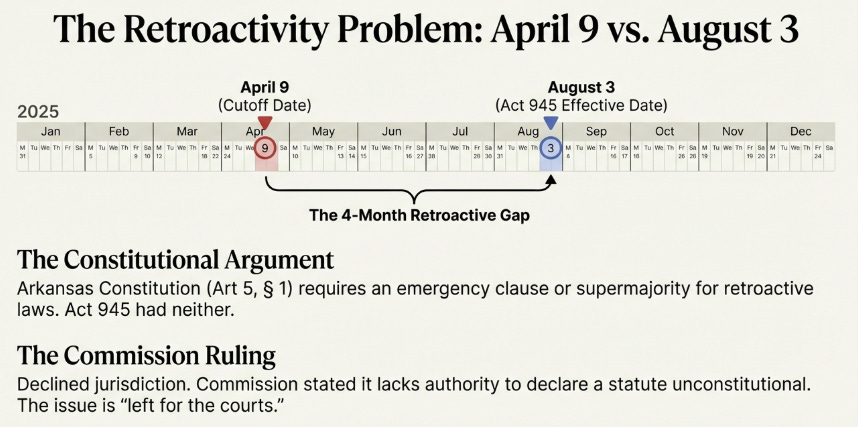
The April 9 cutoff date drew immediate legal fire. Developers noted that it precedes the Act’s effective date by nearly four months, precedes the PSC rulemaking deadline by nearly nine months, and was enacted without an emergency clause or the legislative supermajorities that Arkansas law requires when a legislature intends a statute to have retroactive effect. Those arguments were raised formally in the rulemaking and formally set aside — but they have not gone away.
The Rulemaking: Compressed, Contentious, and Consequential
The Commission opened Docket 25-063-R on October 8, 2025. Administrative Law Judge Justin Craig was assigned to the proceeding by Order No. 2. The timeline was tight: initial comments were due November 6, reply comments November 20, a public hearing was held December 11, and the ALJ’s final order was issued December 29 — eighty-two days from opening to close.
Twelve parties intervened. From the developer side: SREA, Steelhead Americas, and Triple Oak Power filed jointly as the “Joint Developers” throughout. On the utility side: Entergy Arkansas (EAL) and Southwestern Electric Power Company (SWEPCO) filed jointly as the “Joint Utilities.” Community opposition was represented by Concerned Citizens of the Ozarks (CCO), organized largely in response to the Nimbus Wind Farm then under construction in Carroll County. Cordelio Services — an independent wind developer — filed its own initial comments. The Commission’s General Staff filed comments and presented a witness at the December 11 hearing. Pulaski County weighed in on behalf of local governments. And the Office of the Attorney General filed a notice of intervention on October 17 and then filed nothing else — a conspicuous silence in a proceeding that included a formal constitutional challenge to the Legislature’s handiwork.
Despite the compressed timeline, the record was substantive. Developer witnesses were cross-examined at the hearing; the ALJ ordered additional post-hearing briefing on decommissioning; and parties negotiated a package of uncontested amendments that resolved a significant number of technical drafting questions. What could not be resolved by agreement — the exemption process, the installation requirements, and the notice rule — became the contested core of Order No. 6.
The Exemption: From Self-Executing to Case-by-Case
The most important decision in the rulemaking, and the one that generated the most sustained opposition, was the ALJ’s treatment of Act 945’s “under development” exemption.
Developers argued the statute is self-executing: a project either meets the criteria or it does not, and Commission approval is not a prerequisite for a qualifying project to continue development. They asked the Commission to codify the exemption in the rules, publish a non-exhaustive list of qualifying studies, and create an optional expedited confirmation process with a 30-day review window. Their proposed Subpart 7 would have allowed developers to voluntarily file evidence of their exempt status and receive formal Commission verification — without any obligation to do so.
The Commission’s General Staff staked out a different position. Staff opposed any self-identification mechanism, arguing it would leave the Commission without visibility into projects in development. Instead, Staff proposed a structured permit-application process modeled on the power-through generation CCN process established in Docket 20-049-U, with a 45-day review timeline built into the rules. CCO’s counsel at the December 11 hearing stated that CCO endorsed Staff’s proposed process. Pulaski County called for clarity and expeditiousness. No party proposed a timeline longer than Staff’s 45 days; no party objected to having a defined timeline.
The ALJ rejected both proposals. Order No. 6 declined to codify the exemption in the rules, declined to adopt any list of qualifying studies, declined to establish any review timeline, and directed developers seeking exemption confirmation to the Commission’s existing declaratory order procedure under Rule 23 CAR § 462-309(b)(1) — a general-purpose process for removing statutory uncertainty, without any defined review period or structured workflow.
The decision reflects a deliberate three-way institutional choice. The ALJ’s stated rationale is worth reading carefully:
“The eligibility of a wind project for exemption status under Act 945 would be an issue of first impression before the Commission. At the heart of the Commission’s analysis would be determining whether an applicant’s planned wind project was ‘under development’ by April 9, 2025. The Commission would undoubtedly benefit from Staff’s and other interested parties’ analysis of a future applicant’s claimed ‘under development’ exemption(s) and provide testimony to support or deny the exemption in a proceeding that was not subject to an expedited timeline.”
Even criteria that appear self-evident from their statutory text raise issues of first impression, the order observes. The ALJ cited a December 9 public comment from State Representatives James Eaton and Brad Hall, who wrote that commissioners “should consider the amount of acreage leased versus the total project acreage before granting an exemption based on executed land leases.” This comment — from legislators who did not testify at the hearing and were not subject to cross-examination — became the basis for the ALJ’s observation that even “Executed land leases” would require the Commission to determine whether leases must cover a defined threshold of acreage to qualify.
SREA’s rehearing petition argues this was both an improper evidentiary basis and an unlawful expansion of statutory requirements that the Legislature itself chose not to include. On the procedural point, SREA invokes the Commission’s own precedent: “Public comments of utility customers do not rise to the level of substantial evidence upon which the Commission is required by law to base its decision.” On the substantive point, SREA argues that if Representatives Eaton and Hall had the votes to impose acreage thresholds, they could have written them into the bill.
The constitutional challenge to the April 9 cutoff — grounded in Arkansas Constitution Article 5, § 1 and arguing that retroactive deadlines require either an emergency clause or legislative supermajorities — was addressed in a single paragraph. The ALJ declined jurisdiction, citing Arkansas Supreme Court precedent holding that the Commission lacks authority to declare a legislative enactment unconstitutional. The issue was neither resolved nor dismissed on the merits; it was removed from the Commission’s table and left for the courts.
SREA’s rehearing petition adds one more layer to the exemption analysis: it argues that to whatever extent a confirmation process exists, it cannot be mandatory. Act 945 contains no language requiring exempt projects to seek Commission approval before proceeding — and the Arkansas Court of Appeals struck down analogous Commission rules in
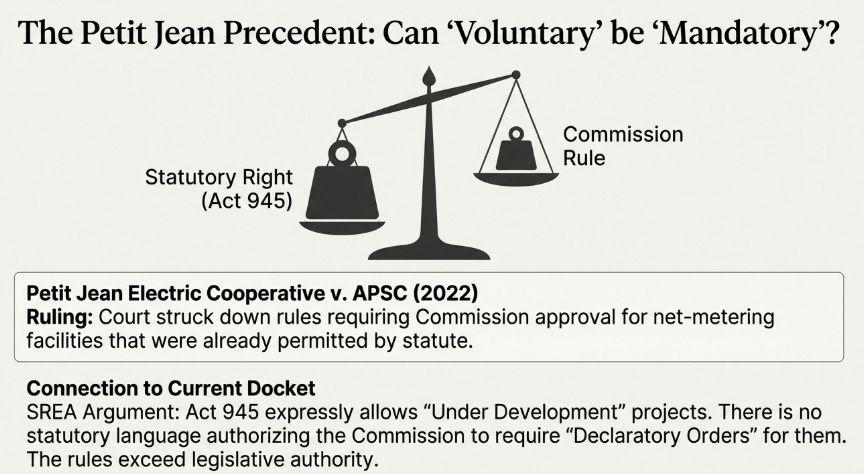
Petit Jean Electric Cooperative v. Arkansas Public Service Commission (2022), which found that requiring Commission approval of net-metering facilities expressly permitted by statute exceeded the Commission’s legislative grant. SREA argues the parallel is direct and the outcome should be the same.
The Installation Rules: A Line Held in the Face of Industry Opposition
Draft Rule 23 CAR § 469-301 requires wind energy facilities to meet three installation standards beyond the minimums set by Act 945 itself: a turbine spacing requirement (minimum five rotor diameters between facilities under different ownership), a prohibition on communications interference with radio, television, or internet service on adjoining properties, and access restrictions requiring either perimeter fencing or a tower-climbing apparatus at least 12 feet from the ground — with an option for internal locked portals on modern tower designs.
Both the Joint Developers and the Joint Utilities sought deletion of the first two provisions. The Joint Developers argued that neither was supported by substantial evidence, that developers have no commercial incentive to site turbines too close to one another given the degradation of turbine performance under such conditions, and that industry “good neighbor” practices adequately address interference concerns. The Joint Utilities argued that the communications interference prohibition is vague and overbroad, that “interference” could be claimed at any point during a facility’s operational life potentially stranding the asset, and that the environmental impact requirements already in Act 945 are sufficient to address interference concerns.
The ALJ kept both rules. The reasoning is grounded in Act 945’s own legislative findings — which expressly state that wind development “can have significant potential impacts on the health, safety, and welfare of the members of the communities in which the wind energy facilities are constructed” — and in the Commission’s mandate to promulgate rules relating to the construction, operation, and maintenance of wind energy facilities.
On the Act 940 argument — that the Commission’s installation requirements conflict with state energy policy encouraging a diverse generation portfolio — the ALJ was direct: Act 940’s energy policy goals are limited to dispatchable fuels, and other provisions of that Act expressly exclude wind energy from its provisions. The Joint Developers’ Act 940 argument was dismissed as misplaced.
The evidentiary record was notably thin in support of the rules. APSC Staff’s own witness testified he had received no communications interference complaints from local wind projects. The AG’s counsel testified to the same. Developer witnesses were unaware of any documented safety or interference incidents from their own projects. What the record did contain was unsworn public comment from Carroll County residents near the Nimbus Wind Farm — which the ALJ acknowledged but could not weigh as formal evidence, and which SREA has characterized in its rehearing petition as an insufficient basis for rule adoption under the Commission’s own due process precedent.
Both §469-301(a)(1) and (a)(2) remain in the Final WED Rules. SREA has challenged them on rehearing as exceeding the Commission’s authority to adopt rules “necessary” to implement Act 945 and, specifically as to the communications interference prohibition, as preempted by federal law — a constitutional argument that, if sustained, would void the rule regardless of any Arkansas law basis.
The Pre-Construction Window
One provision that drew significant developer opposition but was ultimately adopted has received less attention than it warrants: the 30-day pre-construction filing requirement in Draft Rule 23 CAR § 469-202(e).
As enacted, the rule requires permit holders to file copies of their insurance policy, acoustics expert report, and financial security documentation at least 30 days before commencing construction. The Joint Developers argued that Act 945 does not require Commission approval of these items, that the filing occurs after a permit has already been granted, and that there is no basis for inserting a construction delay between permit issuance and construction commencement.
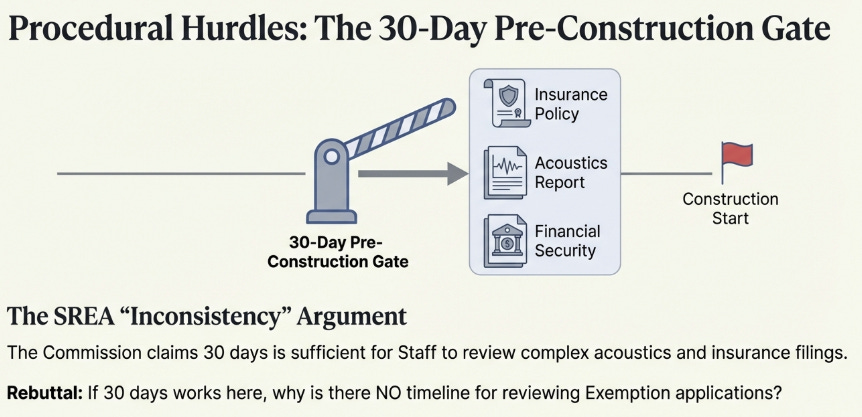
The ALJ disagreed, grounding the 30-day requirement in three separate statutory provisions that contemplate Commission scrutiny: the insurance policy must be “consistent with prevailing industry standards as determined by the Arkansas Public Service Commission”; the acoustics determination must be conducted “according to rules adopted by the Arkansas Public Service Commission”; and the financial security statute requires the applicant to “file with the Arkansas Public Service Commission” tangible evidence of the security. Taken together, those phrases create what the order characterizes as a statutory expectation of Commission review — and 30 days is what the ALJ determined is sufficient.
Notably, this 30-day finding later became the basis for SREA’s internal-inconsistency argument in its rehearing petition: if 30 days is sufficient for Staff to review insurance policies, financial security, and acoustics reports, the petition asks, what is the rational basis for declining to adopt any timeline for reviewing exemption applications, which would involve reviewing leases and study documentation of comparable complexity?
The decommissioning rule, 23 CAR § 469-401, was also finalized in a form requiring pre-construction filings. An independent cost estimate and proof of financial security must be filed in the permit docket at least 30 days before construction begins. The financial security requirement was modified from Staff’s original proposal — which required security held by an “independent fiduciary” — to the Joint Utilities’ alternative language: proof of financial security in one of the forms permitted by statute, “held in a means the Arkansas Public Service Commission determines will satisfy the requirements of the statute.” That is a meaningful distinction. The independent fiduciary requirement would have imposed a specific custodial structure not found in the statute; the Commission-determines-satisfaction language preserves flexibility.
The Notice Rule: The Shadow of Nimbus
The notice requirement in 23 CAR § 469-203(a)(1) — requiring newspaper publication once per week for two consecutive weeks within the 30 days before filing a permit application — was the subject of a Joint Utilities amendment that the ALJ declined to adopt.
The Joint Utilities proposed replacing “two consecutive weeks within thirty days” with “two occasions prior to filing the application” — a change that would accommodate rural newspapers that don’t publish weekly while removing the fixed pre-filing window. The practical case was reasonable. The ALJ’s rejection was grounded in a more specific concern: without a fixed timeline, a developer could publish two notices months before filing, leaving affected community members without adequate notice at the time of actual application.
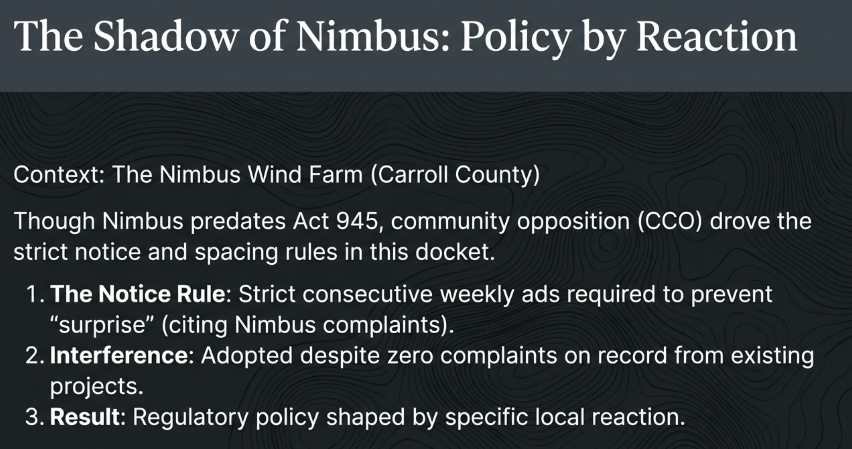
The Nimbus Wind Farm in Carroll County runs through this proceeding as a persistent undercurrent. CCO was organized specifically in response to it. Multiple public comments cited inadequate notice and consultation during Nimbus construction as the animating concern behind community opposition to wind development generally. The ALJ’s decision to maintain the consecutive-weeks-within-30-days requirement reads as a direct policy response to that experience — even though Nimbus predated Act 945 and the rules being promulgated would not have applied to it.
What the Commission Chose Not to Decide
Order No. 6 includes an explicit acknowledgment that several legitimate issues raised in the proceeding could not be addressed within the statutory deadline. The ALJ declined to incorporate five categories of Staff and Joint Utilities recommendations into the Final WED Rules because they “raised issues worthy of further discussion and analysis” without providing a framework adequate for rulemaking within the statutory timeframe. The deferred items are: defining “wind energy facility emergency” under Act 945’s 24-hour reporting requirement; clarifying the $2,500 filing fee payment process; clarifying whether that fee applies to permit renewal applications; specifying requirements for permit transfers under Arkansas Code § 23-18-1404(d); and establishing what “notice” and “approval” mean under the AOGC coordination requirement for facilities in areas with oil and gas operations.
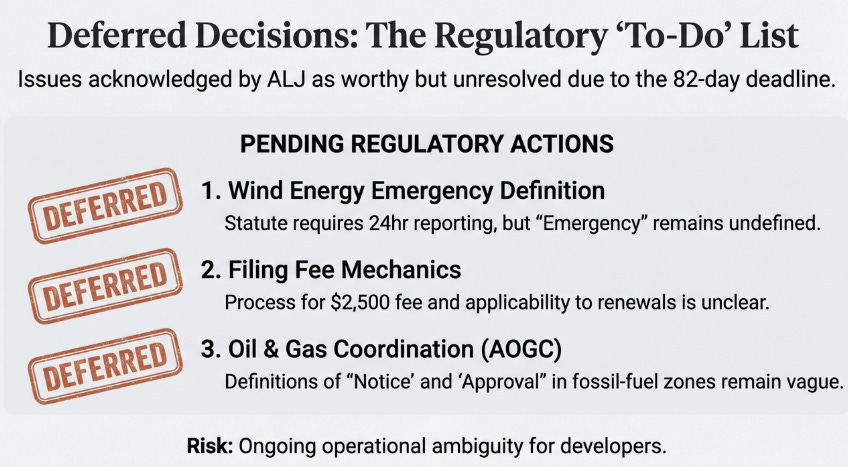
These are not marginal housekeeping matters. The emergency definition has immediate operational significance — Act 945 requires reporting within 24 hours of a wind energy facility emergency, but the term is undefined and no parameters for it appear in the Final WED Rules. The AOGC coordination question affects every applicant in areas with existing oil and gas operations, which encompasses meaningful portions of the state. The ALJ expressly encouraged the parties to revisit these issues in a future rulemaking docket, “when not encumbered by a statutory deadline, to allow for a full and fair consideration of the issues presented.” As of this writing, no such docket has been opened.
From ALJ to Commission: Orders 6 and 7
ALJ Craig’s Order No. 6, issued December 29, 2025, adopted the Draft WED Rules as amended — a redlined version and a clean copy were attached as Attachment A and Attachment B, respectively. The ALJ noted that this order would become the final order of the Commission within thirty days absent Commission action, per the terms of Order No. 2.
The Commission acted on January 14, 2026, issuing Order No. 7 — a two-page order adopting Order No. 6 in its entirety with a single modification. The Final WED Rules, Order No. 7 states, will not take effect on the date of adoption. They will become effective “upon approval by the Governor and the Arkansas Legislative Council, and ten (10) days after the filing of the final rule with the Arkansas Secretary of State, pursuant to Ark. Code Ann. § 25-15-204.”
This is a standard requirement under Arkansas administrative law, but it has immediate practical significance. Until the Governor approves and the ALC formally votes to approve the rules, the Wind Energy Development Rules have been adopted by the Commission but do not have the force of law. Any permit application filed before that point is made against a regulatory framework that is not yet operative. Given that SREA’s rehearing petition was filed February 13, and the ALC calendar runs on its own schedule, the effective date of the Final WED Rules is as consequential as their content.
SREA’s Rehearing Petition: Five Arguments for Reversal
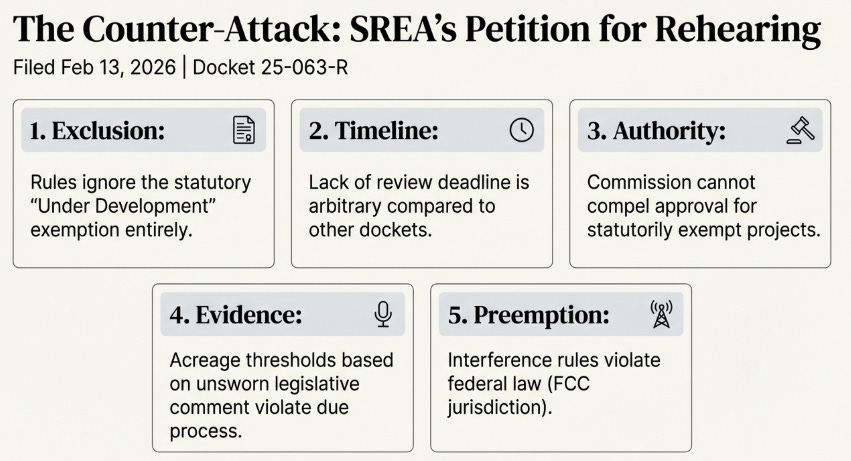
On February 13, 2026, SREA filed a detailed petition for rehearing challenging five aspects of Orders 6 and 7. The petition is grounded in Arkansas Code § 23-2-422 and argues that Order No. 6 implements Act 945 in a manner that is “unjust, arbitrary, unreasonable, unlawful, and discriminatory” and that exceeds the Commission’s statutory authority.
The Exemption Exclusion
SREA’s first argument is the most procedurally basic: the Final WED Rules do not reference the statutory exemption at all, even though no party disputed that it exists and no party objected to its inclusion. Excluding a statutory provision from implementing rules without any findings of fact or conclusions of law explaining the omission is, SREA argues, arbitrary and capricious per se.
The Missing Timeline
SREA’s second argument is the internal inconsistency: the ALJ found 30 days sufficient to review insurance, financial security, and acoustics documentation but provided no explanation for why no timeline should govern review of exemption applications. SREA draws a detailed comparison to the timeline the Commission found reasonable for reviewing a $1.6 billion major utility facility application in Docket 25-047-U — which proceeded to hearing within 90 days and received a Commission order within six months — and argues it would be arbitrary and capricious to deny even a comparable process for wind projects simply seeking to confirm exempt status.
Optional vs. Mandatory
SREA’s third argument challenges the premise that the Commission can require exempt projects to seek formal confirmation before proceeding. Act 945 contains no language authorizing Commission approval of exempt facilities. SREA invokes
Petit Jean Electric Cooperative v. Arkansas Public Service Commission (2022 Ark. App. 215), in which the Arkansas Court of Appeals struck down Commission rules requiring approval of net-metering facilities that were expressly permitted by statute, finding the Commission had acted beyond its legislative grant. The parallel is direct: wind energy facility projects that meet the under-development exemption “are expressly allowed by Act 945, and there is no language authorizing the Commission to require approval.”
Land Lease Acreage and Due Process
SREA’s fourth argument addresses the land lease acreage issue directly. SREA argues the Commission exceeded its authority by suggesting it may impose acreage thresholds not found in the statutory text, based on unsworn comments from two state legislators. The Commission’s own precedent holds that public comments do not constitute substantial evidence and that basing Commission decisions on unconfronted testimony violates due process. SREA asks the Commission to remove this finding from the order.
Section 469-301 and the §469-301(a)(2) Preemption Argument
SREA’s fifth argument challenges the communications interference prohibition and the turbine spacing requirement as exceeding the Commission’s authority to adopt rules “necessary” to implement Act 945. On the interference rule specifically, SREA argues federal preemption — a constitutional bar to state regulation in a field occupied by federal authority. This argument, if sustained, would void §469-301(a)(2) regardless of any state law basis.
SREA has requested that the Commission modify, clarify, and reverse Order No. 6 in part; make detailed findings of fact and conclusions of law on the contested issues; and redesignate the matter for further consideration as needed. The Commission has not yet responded.
What Happens Next
Three milestones will shape the practical significance of everything in Docket 25-063-R over the coming months.
The ALC approval vote determines when, and in what form, the rules take effect. Until that vote occurs, the Wind Energy Development Rules are adopted but not operative. The Commission’s notification that the Governor has approved the Draft Rules as proposed — referenced in Order No. 6 — indicates gubernatorial sign-off has occurred, but ALC approval is a separate and independently required step under Arkansas Code § 25-15-204.
The Commission’s response to SREA’s rehearing petition will determine whether Order No. 6 is reopened before the rules take effect. The Commission has broad discretion under 23 CAR § 462-414(d): it can uphold without modification, modify or clarify on the existing record, reopen for further evidence, reverse in part, or issue an order granting rehearing solely for further consideration. Given that the petition targets the three most contested provisions of the order, any substantive response will reshape the regulatory landscape for wind permitting in the state.
The first exemption application — whatever docket number it receives — will be the proof of concept for the Commission’s chosen case-by-case declaratory order process. The Ozark Shiner Wind project, filed as Docket 26-010-U, has been identified in subsequent Commission filings as a potential early test. When that application is formally adjudicated, every ambiguity the Commission declined to resolve in Docket 25-063-R becomes a live contested issue: what studies qualify, whether executed leases covering a portion of a project footprint suffice, whether the process is voluntary or compelled, what the Commission will actually require as evidence, and on what timeline it will act.
Arkansas has entered a chapter of its energy regulatory history without a directly comparable prior reference point. The Commission has adopted rules, declined to answer the questions those rules most needed to answer, and invited the parties to prove their cases individually in future proceedings. Whether that approach reflects institutional prudence in the face of genuine first-impression complexity — or regulatory deflection dressed as flexibility — is a judgment the courts may yet render.
Key Documents
Order No. 1 (10/8/2025) · Order No. 6 (12/29/2025) · Order No. 7 (1/14/2026) · SREA Rehearing Petition (2/13/2026) — Docket 25-063-R, Arkansas Public Service Commission
Relevant Statutes: Ark. Code Ann. § 23-18-1401 et seq. (Act 945, 2025) · § 23-18-1418 (exemption) · § 23-18-1403(15) (”under development”) · § 25-15-204 (administrative rules effectiveness)
Blackburne Research prepares independent regulatory intelligence for the energy sector. Analysis reflects publicly available docket filings and does not constitute legal advice.